Category: Uncategorized

  • 5 Mistakes to Avoid When Ordering Custom Golf Towels

    5 Mistakes to Avoid When Ordering Custom Golf Towels

    Custom golf towels look like the easiest promotional item you will ever order, which is exactly why so many orders come back looking cheaper than they should. The towel is fine, but the logo is fuzzy, the clip does not fit the bag, or the boxes arrive the week after the tournament. Almost every one of those outcomes traces back to a decision the buyer made without realizing it was a decision. Here are the five that cost people the most, and how to avoid each one, in the order you should actually make them.

    Mistake 1: Choosing a decoration method that fights the fabric

    The single most common error is picking a look before checking whether the fabric can carry it. The three methods do not interchange. Embroidery stitches polyester thread into the cloth and holds up beautifully on solid, flatter faces, but it cannot render a photo or a gradient and it disappears into deep loops. Screen printing lays ink on the surface and works well on a smooth cotton terry velour face, but on waffle or looped microfiber the ink sinks into the texture and fine edges soften. Dye sublimation produces full-color, edge-to-edge, fade-resistant graphics, but it only bonds to polyester, so it works on microfiber and does essentially nothing on cotton. Decide the fabric and the decoration together, not one and then the other.
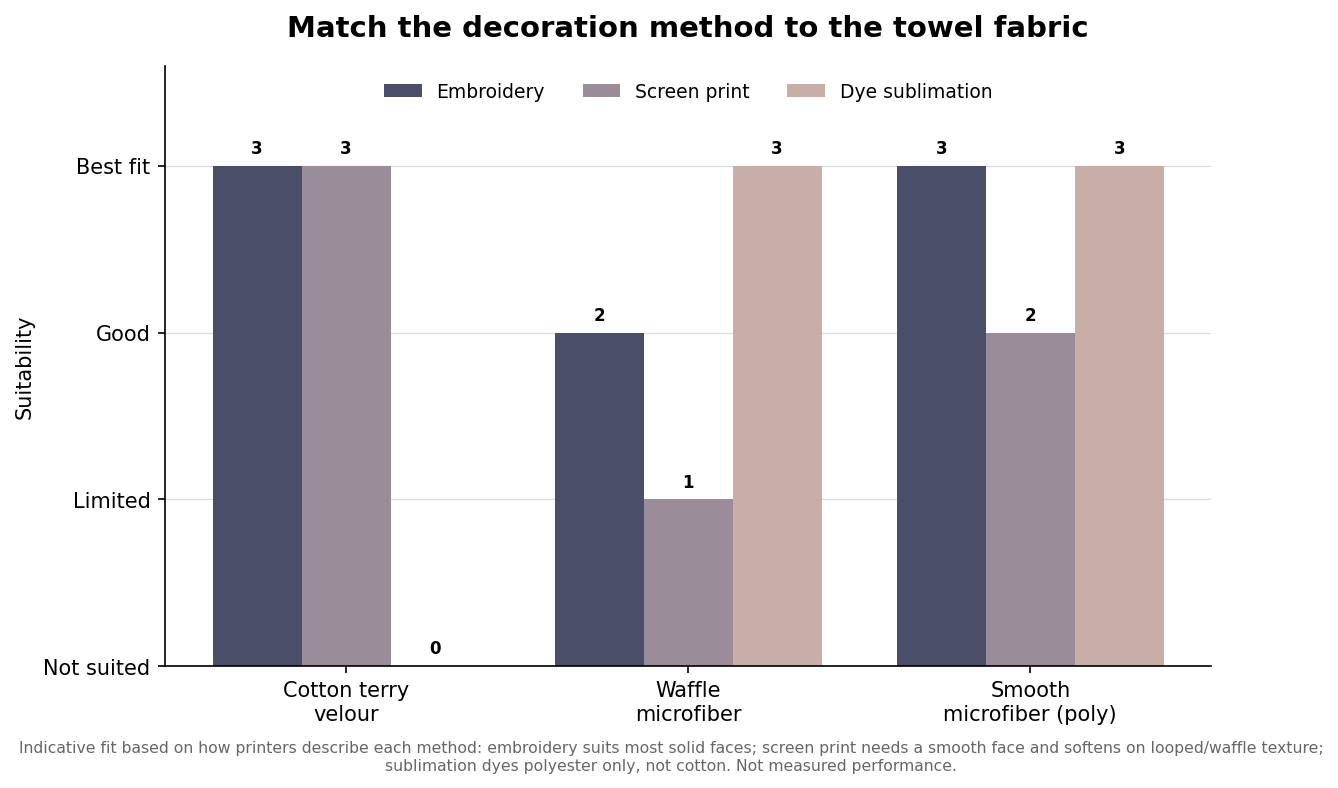
    Grouped bar chart showing embroidery, screen print, and dye sublimation suitability across cotton terry velour, waffle microfiber, and smooth microfiber
    Embroidery suits most solid faces, screen print needs a smooth surface, and sublimation only bonds to polyester microfiber, not cotton.

    The practical rule: if you need a full-color or photographic design, start from a polyester microfiber towel and plan on sublimation. If you want a premium, tactile logo, choose embroidery and a towel with a flat area to stitch. If you are printing a bold one- to four-color sponsor mark at volume, screen printing on smooth terry is the value play.

    Mistake 2: Designing artwork the method cannot hold

    Even the right method fails if the art ignores its limits. Embroidery typically prints up to around four inches wide and runs on the order of eight thousand stitches for a standard logo, so tiny text, hairlines, and intricate detail either get dropped or turn into a lump of thread. Screen printing handles roughly up to four spot colors cleanly and rewards bold shapes over fine linework, because ink spread on a looped surface eats small detail first. Sublimation is the forgiving one for complexity, since it can carry gradients and photos, but it still needs a polyester base to land on. Send vector art, convert text to outlines, and simplify anything that depends on detail smaller than a pencil tip. When in doubt, ask for a stitch-out or a printed proof before committing the full run.

    Mistake 3: Buying a size and clip that do not match how it is used

    Golf towels come in a wide footprint range, and the size changes both how it performs and how it attaches. A pocket towel near sixteen inches square is compact but wipes little; a tri-fold around sixteen by twenty-one keeps a wet zone and a dry zone; a standard towel about sixteen by twenty-five is the giveaway default; and a tour or caddy towel near seventeen by thirty-six is the big, premium option. Attachment follows the format: tri-fold towels usually hang from a center grommet with a carabiner, while flat towels clip from a corner grommet and hook. Buying a large flat towel and expecting it to ride neatly on a cart, or a center-clip tri-fold when your recipients wanted a corner hook, is the kind of mismatch nobody notices until the towels are in hand.
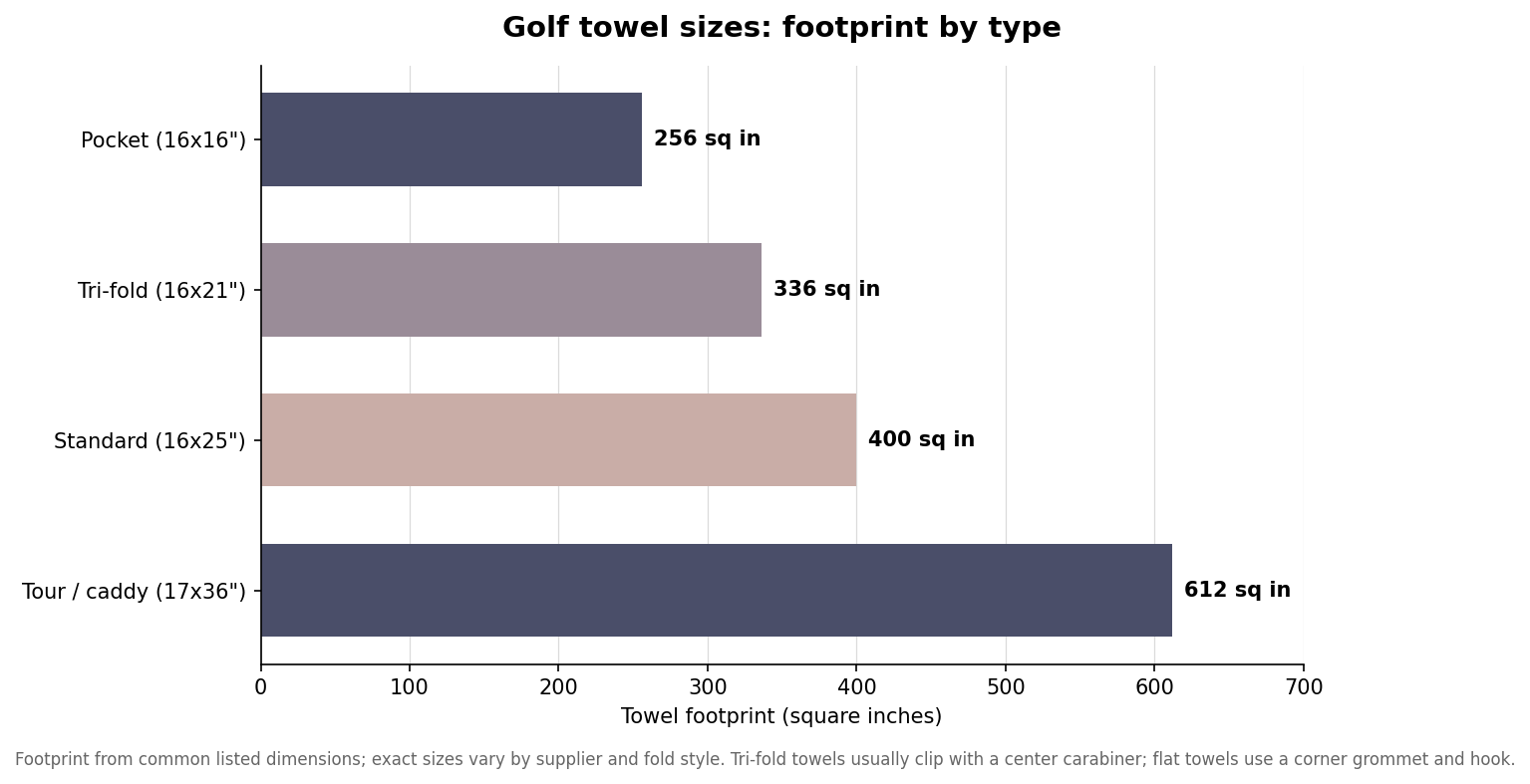
    Horizontal bar chart comparing golf towel footprint in square inches for pocket, tri-fold, standard, and tour or caddy towels
    Golf towel footprints range from a compact pocket towel to a large tour or caddy towel, and the size drives how it clips to the bag.

    Mistake 4: Treating towel weight as a footnote

    Weight is not just heft; it sets absorbency, drying speed, and cost. Heavier towels, often quoted around three and a half pounds per dozen for a heavyweight terry, feel plush and soak up more, but they dry slower and cost more to make and ship. Lighter towels, closer to one to two pounds per dozen, are cheaper and quick-drying but thinner in the hand. For a one-day tournament giveaway, a midweight towel photographs well and keeps the budget sane; for a pro shop item people use all season, the heavier hand justifies itself. Decide what the towel is really for before you optimize for the lowest per-unit price, because the cheapest towel that feels flimsy undercuts the logo you put on it.

    Mistake 5: Underestimating lead time and minimums

    Custom towels are made to order, and standard production at Get Custom Golf Towels is about 2 weeks after proof approval, with a minimum order of 12 towels. That timeline stretches in golf season and on large runs, which need extra buffer. The fix is boring and effective: order at least three to four weeks out from a firm event date, count from proof approval rather than from when you place the order, and get the proof approved fast so the clock actually starts. A towel that arrives the Monday after the scramble is a total loss no matter how good it looks. Express shipping is available as an optional upgrade, but it costs more and still needs an approved proof to begin, so it is a safety net rather than a plan.

    Run the decisions in order and the mistakes mostly disappear: pick the fabric, match the decoration to it, size the towel and clip to how it will be used, choose a weight that fits the purpose, and back the whole thing up against the calendar. Do that and a custom golf towel stops being a gamble and becomes the reliable, good-looking giveaway it was supposed to be.

  • Waffle, Terry or Microfiber? The Honest Comparison

    Every golf towel is one of three fabrics, and suppliers rarely explain the trade because explaining it means admitting the expensive one is not always right.

    Cotton terry: the familiar one

    Soft, heavy, absorbent in absolute terms, and what most people picture when they hear ‘towel’. It is gentle on club finishes and pleasant to handle.

    Its problem is drying. A soaked terry towel is still damp the next morning, and a damp towel in a bag stays damp. It also holds grit in the pile, which is the opposite of what you want against a driver crown.

    Cotton waffle: the club standard

    The honeycomb weave creates more surface area per gram than terry, so it absorbs more for its weight, and the open structure releases water fast — dry overnight rather than damp for days.

    It also takes embroidery better than any other option, because the raised waffle gives stitching a structure to sit against. For a club towel with a crest on it, this is almost always the right answer.

    Microfiber: the technical one

    Split synthetic fibers pull water and grit up into the pile rather than pushing it around. It holds several times its weight in water, wrings out nearly dry, and dries in a fraction of the time of any cotton.

    It is also the only fabric that takes full-color sublimation. The trade-offs are hand feel — it is a synthetic and feels like one — and that it should never see fabric softener, which coats the fibers and destroys the absorbency.

    Which one for which buyer

    Club and society bag towels: waffle cotton, embroidered. Pro shop retail: waffle and microfiber side by side, because players are split. Resort and premium: plush microfiber or 500gsm caddy cotton. Sponsor and championship panels: sublimated microfiber, no alternative.

    Corporate tee gifts: waffle, because it is the one recipients keep using, and the cost sits in the right place.

    The mistakes we see most

    Ordering terry because it feels best in the showroom, then hearing about damp bags all season. Ordering microfiber for a traditional club whose members wanted cotton. And ordering cotton with a photographic design on it, which simply cannot be produced.

    All three are avoidable in a two-minute conversation, which is why we have it before quoting rather than after.

    Care, briefly

    Cotton: warm wash, tumble low, and it will keep improving for a season. Microfiber: warm wash, no fabric softener, no high heat. Softener is the single most common way a good microfiber towel gets ruined, and it is worth printing on the care label.

  • Planning Tee Gifts for a Golf Day Without Losing a Weekend

    The gift itself is rarely what goes wrong with a corporate golf day. What goes wrong is somebody’s Saturday, spent filling four hundred bags on a function room floor the night before.

    Order to headcount plus a margin

    Add about five percent over confirmed players. There are always late entries, a sponsor who wants a set, and a couple that get damaged or handed out twice.

    Running out at registration is far more visible than a small box left over, and the marginal cost of the extra five percent is trivial next to the cost of the shortfall being noticed.

    Decide personalization early, not late

    Individual names carry no per-piece setup charge here, so the cost argument does not apply. What does apply is the deadline: a name list has to be final before production, and player lists for golf days are notoriously fluid.

    The practical answer is to name the towels for confirmed players and leave the five percent margin blank. Nobody notices a blank towel; everybody notices a wrong name.

    Send the pairing order

    If you send the pairing list with your name list, we bag the towels in that order. Registration then works down the box in sequence rather than searching for each name, which removes the single biggest queue at the first tee.

    This costs nothing and almost nobody asks for it.

    Box them, or budget the labor

    Boxed gift sets arrive assembled and sealed — towel, tees, marker, divot tool, printed card, all coordinated. Loose components arrive as loose components, and somebody has to combine them.

    For anything over about a hundred players the assembled option costs less than the hours it replaces, and it is the difference between a calm Friday and a late one.

    Sponsors need to be laid out, not squeezed

    Multi-sponsor events almost always end with six logos crammed into one corner of a towel at unreadable size. A sublimated microfiber towel gives you the whole surface for a proper grid, with the headline sponsor sized accordingly.

    We lay out sponsor grids free. Send the logos and the tier structure and we will come back with something that does not look like an afterthought.

    The timeline that works

    Six weeks out: choose fabric and get the mockup. Four weeks: approve artwork. Three weeks: lock the name list. Two weeks: production. One week: delivered and checked.

    Express turnaround compresses that, and we will confirm in writing whether your date is achievable before you pay anything — but the name list is the step that slips, not the manufacturing.

  • The Complete Buyer’s Guide to Custom Golf Towels

    Golf towels are bought in bulk and judged individually, usually in poor weather by somebody who did not choose them. That is a demanding brief for a rectangle of cotton.

    This guide covers the four specification decisions, in the order they actually matter.

    Weave decides how the towel behaves

    Waffle weave is a honeycomb structure that creates far more surface area than a flat weave at the same weight. It absorbs more per gram, holds water in the pockets rather than on the surface, and dries fully overnight. It is the club standard for good reason.

    Terry is softer and heavier and holds more water in absolute terms, but stays damp far longer. It suits club cleaning better than hand drying. Microfiber outperforms both on absorbency and drying, and it is the only fabric that takes a full-color print.

    Weight, and where more stops helping

    For a standard bag towel, weight matters less than weave. For an oversized caddy towel it matters a lot: below about 400gsm a 20 by 40 inch towel goes limp when soaked and feels cheap.

    Above roughly 550gsm you are carrying water rather than absorbing it, and drying time climbs steeply. 500gsm is where absorbency, hand feel and practicality meet, which is why tour towels sit there.

    The grommet is the detail nobody specifies

    A brass grommet centered in the top panel lets a tri-fold hang square off a bag. A grommet punched in a corner — which is faster to produce and very common — makes the towel twist, so by the back nine it is dragging on the grass.

    It costs nothing to place correctly. Ask, because a supplier who has not thought about it has not thought about the rest either.

    Decoration follows fabric, not preference

    Embroidery on waffle weave is the best-looking combination in golf: the raised honeycomb gives stitching something to sit against, so a crest reads sharply. On flat terry the same stitching sinks into the pile.

    Screen print handles large artwork on cotton. Full-color photographic work — course maps, sponsor grids, commemorative panels — requires dye sublimation, which only bonds to synthetic fiber. That means microfiber, always. Any supplier offering a sublimated cotton towel is describing something else.

    Sizing by use

    16 by 24 inches is the standard bag towel and covers most orders. 15 by 18 is a compact cart towel. 16 by 40 lets a player soak one end and keep the other dry, which is how most low handicappers actually use a towel. 20 by 40 is the caddy or tour size and the best branding surface in golf.

    Buying for an event

    Order to headcount plus about five percent, tell us the date when you request the quote rather than after approval, and send your pairing list if you want the towels bagged in order. Registration then hands out the right named towel without sorting anything.

    Boxed gift sets arrive assembled and sealed. That is worth more than it costs on any event over about a hundred players.

    What to send us

    Your logo in any form, the fabric you are leaning toward, the size, roughly how many, and your date. If names go on individual towels, send a spreadsheet with a name per row and the pairing order if you have it.