Custom golf towels look like the easiest promotional item you will ever order, which is exactly why so many orders come back looking cheaper than they should. The towel is fine, but the logo is fuzzy, the clip does not fit the bag, or the boxes arrive the week after the tournament. Almost every one of those outcomes traces back to a decision the buyer made without realizing it was a decision. Here are the five that cost people the most, and how to avoid each one, in the order you should actually make them.
Mistake 1: Choosing a decoration method that fights the fabric
The single most common error is picking a look before checking whether the fabric can carry it. The three methods do not interchange. Embroidery stitches polyester thread into the cloth and holds up beautifully on solid, flatter faces, but it cannot render a photo or a gradient and it disappears into deep loops. Screen printing lays ink on the surface and works well on a smooth cotton terry velour face, but on waffle or looped microfiber the ink sinks into the texture and fine edges soften. Dye sublimation produces full-color, edge-to-edge, fade-resistant graphics, but it only bonds to polyester, so it works on microfiber and does essentially nothing on cotton. Decide the fabric and the decoration together, not one and then the other.
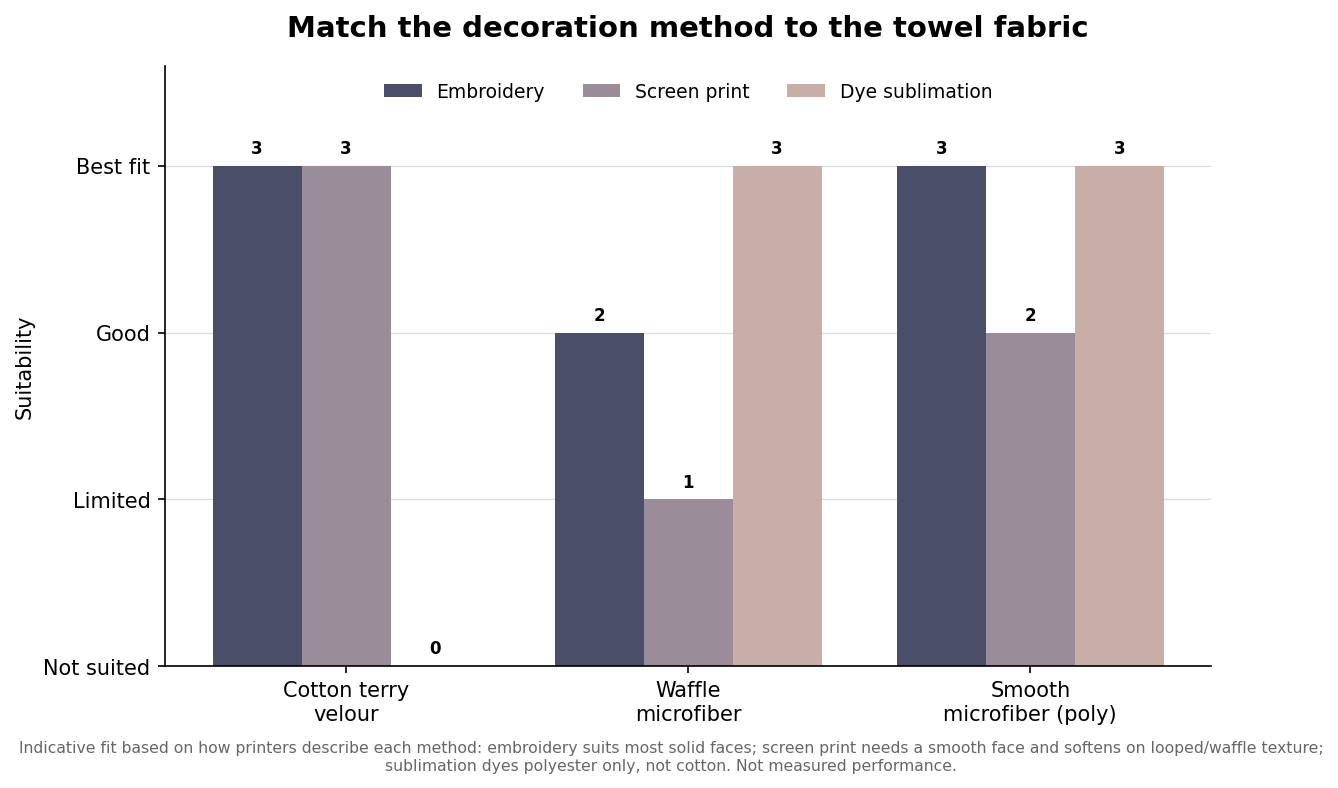
The practical rule: if you need a full-color or photographic design, start from a polyester microfiber towel and plan on sublimation. If you want a premium, tactile logo, choose embroidery and a towel with a flat area to stitch. If you are printing a bold one- to four-color sponsor mark at volume, screen printing on smooth terry is the value play.
Mistake 2: Designing artwork the method cannot hold
Even the right method fails if the art ignores its limits. Embroidery typically prints up to around four inches wide and runs on the order of eight thousand stitches for a standard logo, so tiny text, hairlines, and intricate detail either get dropped or turn into a lump of thread. Screen printing handles roughly up to four spot colors cleanly and rewards bold shapes over fine linework, because ink spread on a looped surface eats small detail first. Sublimation is the forgiving one for complexity, since it can carry gradients and photos, but it still needs a polyester base to land on. Send vector art, convert text to outlines, and simplify anything that depends on detail smaller than a pencil tip. When in doubt, ask for a stitch-out or a printed proof before committing the full run.
Mistake 3: Buying a size and clip that do not match how it is used
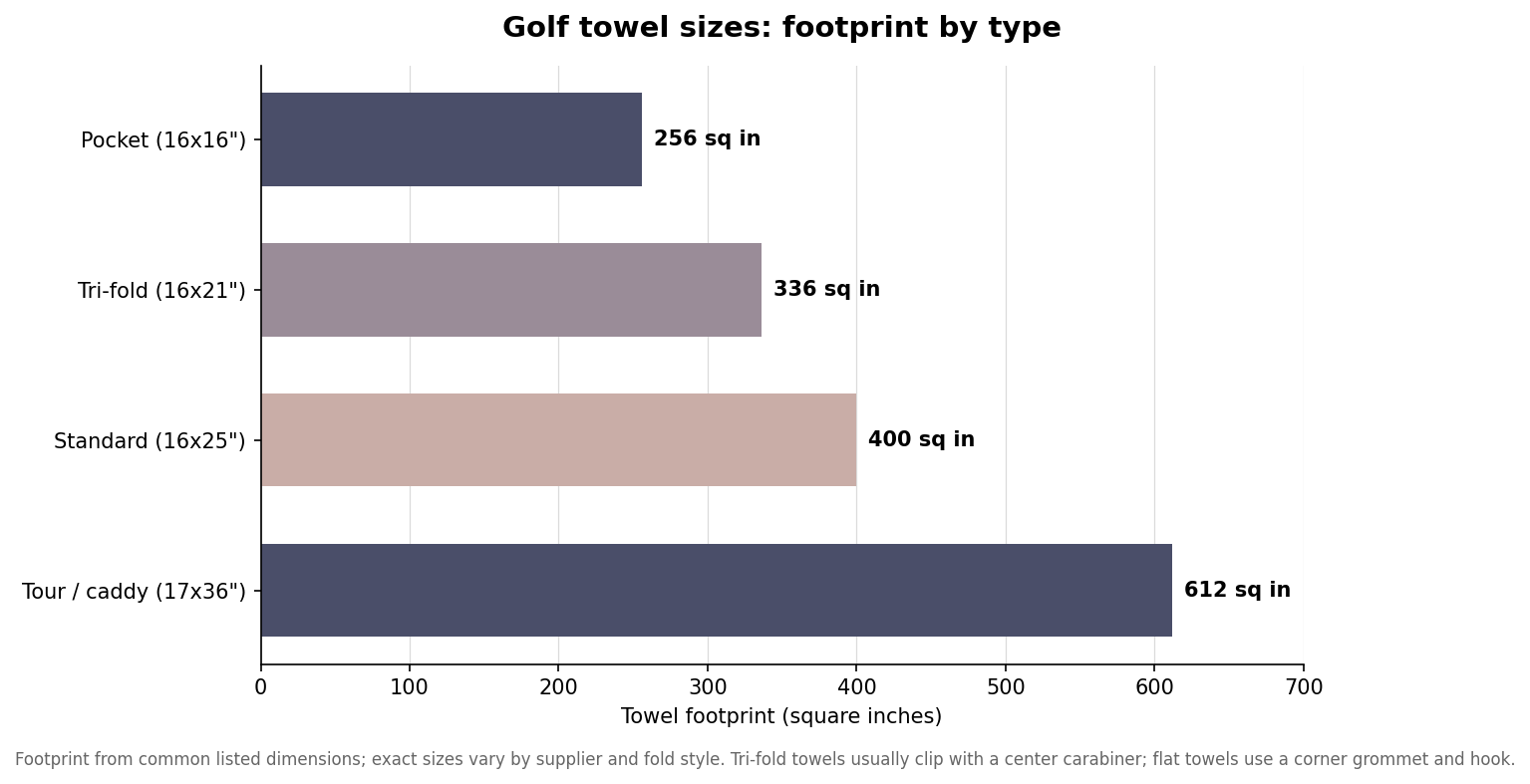
Golf towels come in a wide footprint range, and the size changes both how it performs and how it attaches. A pocket towel near sixteen inches square is compact but wipes little; a tri-fold around sixteen by twenty-one keeps a wet zone and a dry zone; a standard towel about sixteen by twenty-five is the giveaway default; and a tour or caddy towel near seventeen by thirty-six is the big, premium option. Attachment follows the format: tri-fold towels usually hang from a center grommet with a carabiner, while flat towels clip from a corner grommet and hook. Buying a large flat towel and expecting it to ride neatly on a cart, or a center-clip tri-fold when your recipients wanted a corner hook, is the kind of mismatch nobody notices until the towels are in hand.
Mistake 4: Treating towel weight as a footnote
Weight is not just heft; it sets absorbency, drying speed, and cost. Heavier towels, often quoted around three and a half pounds per dozen for a heavyweight terry, feel plush and soak up more, but they dry slower and cost more to make and ship. Lighter towels, closer to one to two pounds per dozen, are cheaper and quick-drying but thinner in the hand. For a one-day tournament giveaway, a midweight towel photographs well and keeps the budget sane; for a pro shop item people use all season, the heavier hand justifies itself. Decide what the towel is really for before you optimize for the lowest per-unit price, because the cheapest towel that feels flimsy undercuts the logo you put on it.
Mistake 5: Underestimating lead time and minimums
Custom towels are made to order, and standard production at Get Custom Golf Towels is about 2 weeks after proof approval, with a minimum order of 12 towels. That timeline stretches in golf season and on large runs, which need extra buffer. The fix is boring and effective: order at least three to four weeks out from a firm event date, count from proof approval rather than from when you place the order, and get the proof approved fast so the clock actually starts. A towel that arrives the Monday after the scramble is a total loss no matter how good it looks. Express shipping is available as an optional upgrade, but it costs more and still needs an approved proof to begin, so it is a safety net rather than a plan.
Run the decisions in order and the mistakes mostly disappear: pick the fabric, match the decoration to it, size the towel and clip to how it will be used, choose a weight that fits the purpose, and back the whole thing up against the calendar. Do that and a custom golf towel stops being a gamble and becomes the reliable, good-looking giveaway it was supposed to be.